A Negative Membrane Potential Indicates Which of the Following
Ions such as sodium and potassium. More positive- Triple the number of Na leak c.
Depolarization Hyperpolarization Neuron Action Potentials Article Khan Academy
The resting membrane potential is negative due to which of the following.
. There are more negatively charged particles on the outside of the membrane than on the inside. What does a negative membrane potential indicate. Neuronal synapses chemical The synapse.
Membrane potential to become more negative than the resting membrane potential. Electrolytes are equally distributed between the extracellular fluid on the outside of the plasma membrane and the intracellular fluid on the inside. Frame a word problem for each of the following and solve them.
The Opening and Closing of Channels Changes Neuronal Permeability During the Action Potential. You immediately note the presence of an orange placard on the side of the tank that the truck is pulling. Indicates that the inside of the cell is negative relative to the outside Resting Potential the difference in charge across the membrane when a neuron is not conducting an impulse.
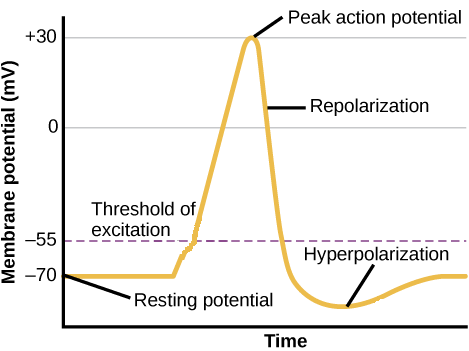
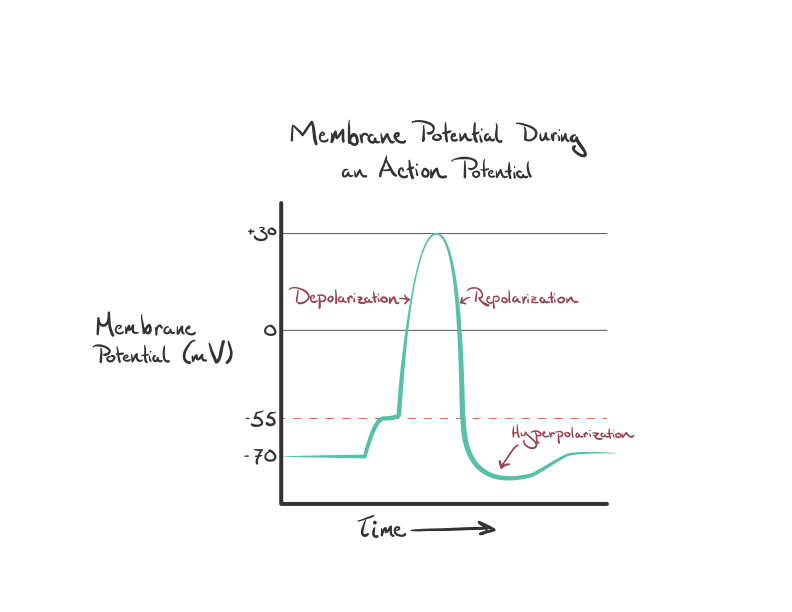
For each of the following indicate whether the condition will cause the membrane potential to become more positive more negative or largely unchanged when compared to the normal physiological resting membrane potential. Neuron depolarization hyperpolarization and action potentials. In neurons the average resting membrane potential value is -70mv.
During depolarization or when the action potential is generated a large number of sodium ions move inside the cell due to the opening of voltage-gated sodium channels that leads to a. 1 Inner side of the membrane is negative to the - 188469 1stBrainly 1stBrainly 27062020 Math Secondary School answered. More leak channels more positive charge leaves.
Membrane potential plays a crucial role in many important physiological processes in bacteria. Following a hypertonic shock the plasma membrane was rapidly hyperpolarized. The inside of the membrane is negatively charged relative to the outside.
In general the membrane is slightly negative or has a slightly negative potential but this can change in the following cases. An increase in charge separation leading to a more negative mem- brane potential is called hyperpolarization. Electrotonic and action potentials.
Show transcribed image text For each of the following indicate whether the condition will cause the membrane potential to become more negative or largely unchanged when compared to the normal physiological resting membrane potential. This process is called hyperpolarization. This is the currently selected item.
It is a component of the proton-motive force and is used to power various membrane-embedded complexes including ATP synthase the flagellar motor and various small-molecule transport systems 1 5Membrane potential has also been shown to. The signal observed during dissipation of the plasma membrane potential by the addition of excess K and valinomycin or a protonophore was taken as a measure of the preexisting potential. A negative membrane potential indicates which of the following.
Electrical currents in neurons are due primarily to the flow of which of the following through gated channels. Part For each of the following indicate whether the condition will cause the membrane potential to become more positive more negative or largely unchange membrane potential Drag the appropriate items to their respective bins. Which of the following elements is most.
For each of the following. A 1270 x 324. If there are more cations positive ions entering the cell due to more channels especially Na.
By the end of the hyperpolarization all the potassium channels are closed. This indicates that the vehicle is carrying aan _____ agent. Label this graph.
Saltatory conduction in neurons. A re- duction of charge separation leading to a less negative membrane potential is called depolarization. This minus - sign indicates that.
Excitable cells have an electric potential that is developed as a consequence of the difference in the concentration of ions inside and outside the membrane. Depolarize more positive because there is more Na outside at RMP so Na going down its gradient would be moving into the cell. What ionic movement is responsible for pulling the membrane potential back to a negative voltage during an action potential.
View the full answer. Drag the appropriate items to their respective bins. A resting potential of -85 to -100 millivolts negative inside was calculated.
Lets consider a scenario in which the resting membrane potential changes from 70 mVmV to 70 mVmV but the. Hyperpolarize more negative because there is more K inside at RMP so to go down its gradient it moves out. If the number of Na reduces or K increases.

Ch 11 The Nervous System Flashcards Quizlet
What Are The Changes In Membrane Potential During An Action Potential Quora
Neuron Action Potentials The Creation Of A Brain Signal Article Khan Academy


Comments
Post a Comment